Practices Make Great Leadership: What We Learned from Partnering with the London School of Economics
31
Mar
2026
Written by Andy Chevis, Chief Learning Officer, LIW

Each year, LIW partners with the London School of Economics to sponsor a research project that deepens the practice of leadership. It’s a collaboration we deeply value. Grounded in a shared belief: leadership isn’t a role, position or a personality, it’s a collection of observable, learnable behaviours that shape real-world outcomes.
The 2025 project, led by Marion Lang and Sebastian Lessing, explored the role of deliberate leadership practices in driving organisational performance.
Through rich, in-depth interviews with senior leaders across global firms and deep analysis of a broad spectrum of new and tested research, the project put our own leadership practices model under the microscope.
We asked Marion and Sebastian to treat our 4 practices model as a hypothesis and test its validity against solid research as well as firsthand experiences of practicing leaders in different roles, industries and contexts.
The good news is that the findings did validate our framework. The better news is that it enhanced the depth and nuance of the individual practices. It also delivered some practical direction on the approach to leadership development and effective application.
Leadership that shows up through practice
At LIW, we’ve long advocated for a behavioural model of leadership built around four interconnected practices. Practices that if cultivated and consistently applied, can be utilised in any situation to improve impact on individuals and the environment within which performance can be cultivated
We set out with the intention to simplify the act of leadership, distilling it into an accessible set of behavioural patterns that could be consistently practiced, to help leaders engage and act, immediately after training. Making it easier to practically apply their learning in their day-to-day work and experience positive, tangible outcomes that would encourage them to continue their development long after the formal learning program.
Out of this work, the Four Practices were born:
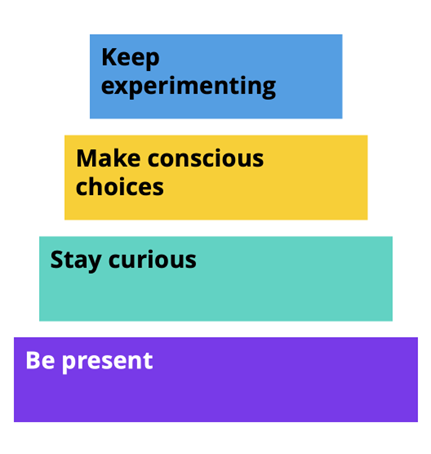
- Keep Experimenting: Testing and evaluating hypotheses with clear desired outcomes. Learning in motion through iteration and feedback.
- Make Conscious Choices: Effective evaluation of clean data and balanced decision making. Acting with intention, clarity, and alignment.
- Stay Curious: Practising open, non-biased questions and deep listening. Seeking diverse perspectives with openness and empathy.
- Be Present: Maintain a calm awareness of oneself, others and the broader system. Creating space for others through attention, availability, and care.
The LSE research shows how these practices are not only observable in today’s most effective leaders they reinforce each other in action. For example, presence enables curiosity by creating the conditions for real dialogue. Conscious choice gains strength when paired with experimentation and evaluation. The power lies not in any one behaviour, but in the interplay between them.
The Six Themes Behind Leadership Impact
The LSE research identified 20 key behaviours that enable leadership effectiveness, grouped into six overarching themes:
- Relationship-building
- Empowerment
- Communication
- Decision-making
- Vision
- Learning
Together, these themes map directly onto LIW’s four practices:
- Be Present underpins relationship-building, empowerment, and trust. Leaders who were described as authentic, available, and consistent were also those who created psychological safety and followership.
- Stay Curious emerged strongly in communication and decision-making. The best leaders adjusted their style to the audience, listened actively, and invited other perspectives.
- Make Conscious Choices was called out specifically as ‘decision making’ and came through in how leaders framed change, balanced instinct and data, and aligned decisions with longer-term strategy.
- Keep Experimenting was singled out specifically to enable learning and present in behaviours like encouraging risk-taking, building feedback cultures, and developing through iteration.
In other words: our four practices aren’t abstract values. They’re alive and working in the day-to-day moments where leadership really happens.
A Shift Toward Intentional Leadership
What’s especially powerful in this research is the way it reframes leadership not as a fixed trait, but a set of intentional behaviours. Leaders weren't described as “naturally” inspiring they were deliberate, consistent. They made choices about how to show up, how to listen, how to communicate, and how to learn.
This has direct implications for how we design leadership development. Based on the research, this is what was identified as being the key areas of focus, creating clear practical organisations can take to enhance leadership effectiveness:
- Break big ideas into teachable practices. Instead of generic competencies, focus on micro-behaviours like “adjust your communication to the context” or “respond to mistakes with calm, not blame.”
- Make learning experiential. Leaders credited growth to practice, reflection, and peer dialogue not theory. Design programmes that simulate lived experience.
- Encourage behavioural intention. Build in reflection tools that prompt leaders to ask: What am I modelling? What’s the impact? What needs to shift?
- Develop pattern recognition. Train leaders to read their context andadapt to the needs of their teams through practice.
From Research to Real-World Impact
This work with LSE confirms what we see in the organisations we support every day: the most effective leaders don’t just think differently they practise differently. They lead through small, deliberate actions that build trust, unlock insight, and develop the environments that drive performance.
Leadership is not something you have. It’ssomething you do, and keep doing every day.
If you are interested in knowing more about thisresearch or the work we do in partnership with LSE, please get in touch.