The One Metric That Proves Your Leaders Are Rubber-Stamping AI
19
Oct
2026
Written by Taylor Hawkins, Managing Consultant & Foresight Practice Lead Asia Pacific

Competence is thinning where it looks strongest.
A Harvard Business School study demonstrated that while consultants using AI within its capabilities performed better, those assigned complex tasks outside the AI's capabilities performed worse than the control group - because they stopped developing independent approaches. Researchers named this phenomenon the "jagged technological frontier" (Dell'Acqua et al., 2023).
Similarly, a randomised study of software developers found that AI tools made them 19% slower on complex real-world tasks, even while the developers believed the tools had made them 20% faster (METR, 2025).
There is a widening gap between what leaders feel AI is doing for them and what it measurably does. As managers and executives increasingly rely on automated synthesis and recommendations, organisations face a silent threat: quiet deskilling through convenience.
The Four Drift Markers: How to Spot Ceded Ownership
In LIW’s Leadership-AI Relationship Model (LARM), organisations naturally experience a downward pull toward the Ceded row - where leaders maintain nominal accountability, but the system handles the substance.
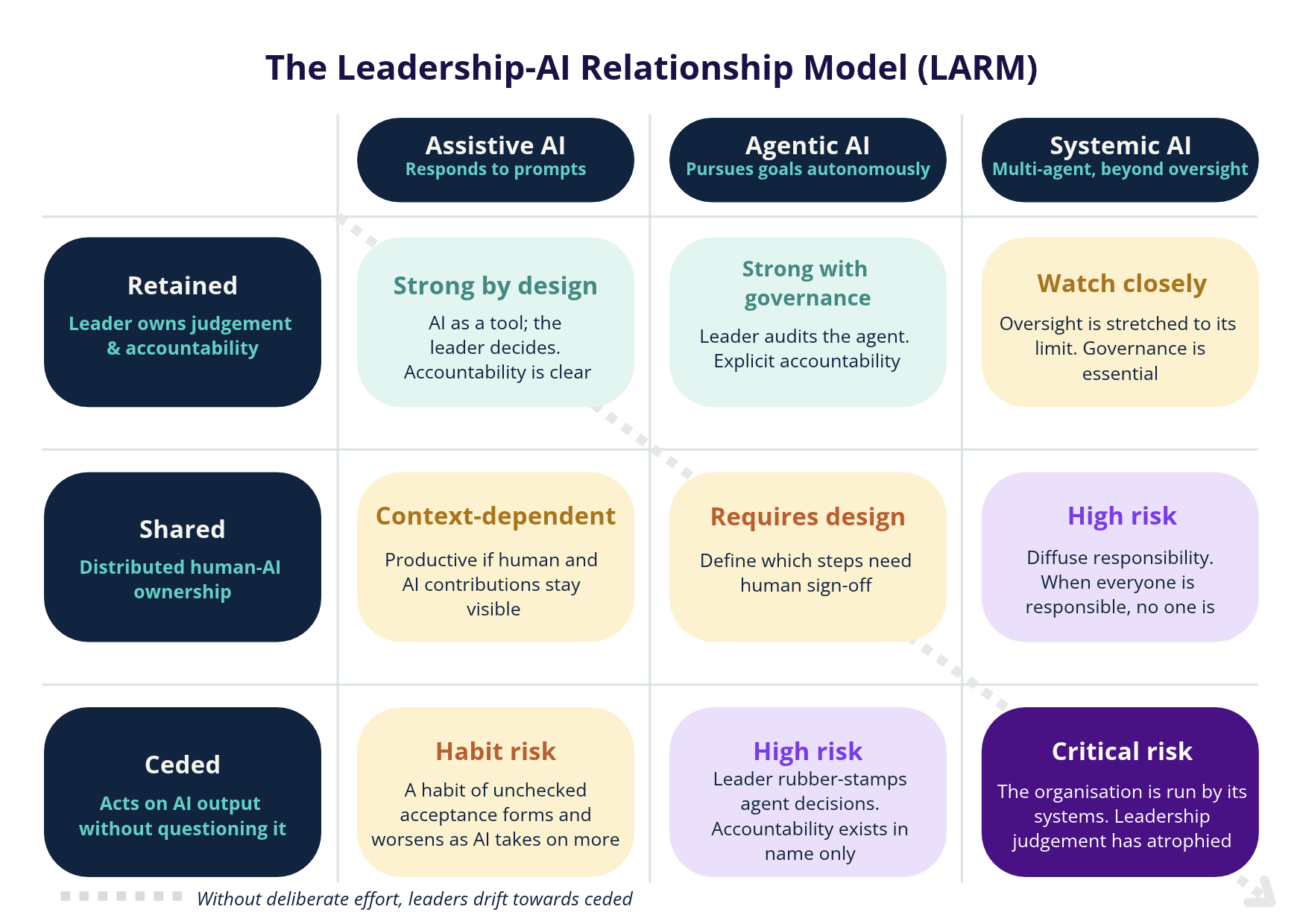
Because cognitive offloading happens quietly, drift is often invisible to the people drifting. However, four clear markers make this drift measurable using data most organisations already hold:
- Ratification Rate: The share of AI recommendations accepted without modification. A rate climbing toward 100% signals ceded responsibility.
- Time to Accept: The gap between receiving an AI output and acting on it. When this gap collapses, human interrogation and judgement have stopped.
- Documented Dissent: How often a leader records disagreement with an AI recommendation. The total absence of dissent is an immediate warning signal.
- Reconstruction Ability: Whether a leader can explain a recent AI-assisted decision without reopening the tool. If the reasoning lives only in the system, so does the judgement.
Action: Measure Quarterly Ratification Rates
Want to ensure that your leaders aren’t just blindly rubber stamping AI?
Pick one material class of AI-assisted decisions and measure its Ratification Rate quarterly.
Tracking this single metric takes capability risk out of the abstract and makes drift discussable at the executive level. If your ratification rate is climbing toward 100% or your time to accept is collapsing to zero, your organisation is no longer being led by its people - it is being run by its systems.
Take Control of AI Governance
Measuring ratification rates is only the first step in protecting human judgement across your leadership pipeline.
👉 Download the full ‘The capability you should never hand to a machine’ Whitepaper to explore the broader drift governance framework, including board-level risk controls, procurement standards for cognitive forcing functions, and the 90-day execution roadmap.