Why Designing Better Leadership Programs Starts Before the Design
22
Jul
2026
Written by Kathryn Loadsman, Lead Designer

Leadership development often begins with a request like this:
“We need a workshop on coaching.”
Or:
“We want a program on courageous conversations.”
Or:
“Can you design a leadership pathway for frontline managers?”
The topic is clear. The format is usually clear. The audience is often clear.
But the business problem? That’s where things tend to get vague.
And that vagueness matters more than most organisations realise, because it shapes everything that follows. Vendors respond to the topic they are given. Programs get built around themes. Learning objectives are written around concepts leaders should understand.
But the connection between the learning and the business outcome often remains thin from the very beginning.
When that happens, leadership development becomes difficult to evaluate properly. Proposals start sounding interchangeable. Stakeholders struggle to articulate what success would actually look like.
And then, a few months on after delivery, someone eventually asks what changed in the business. And the room goes quiet.
Often, there is no clear answer. Not because the provider was poor. Not because the facilitators lacked capability. But because the brief itself never clearly defined the links between leadership behaviour and business impact.
That is the problem the Leadership Impact Chain is designed to solve.
The Process we use before Solutions are Designed
When organisations engage us to design leadership development, we rarely start by talking about workshops, modules, or learning activities. We start further upstream.
Before design begins, we work with clients through a discovery and definition process focused on one core question:
What is the business actually trying to achieve, and what would leaders need to do differently to help achieve it?
The Leadership Impact Chain is the framework we use to guide that work.
Because the clearer the logic connecting leadership behaviour to business outcomes, the stronger the learning brief becomes and the easier it is to design something that will genuinely matter.
We are sharing the model here because it is a useful thinking tool in its own right. You can absolutely use it internally to sharpen learning objectives, align stakeholders, and improve the quality of vendor conversations.
But it is also the process we facilitate with clients during the early stages of engagement, helping teams move from broad capability themes to a much clearer definition of the performance and business outcomes leadership development is intended to support.
The model itself is simple:
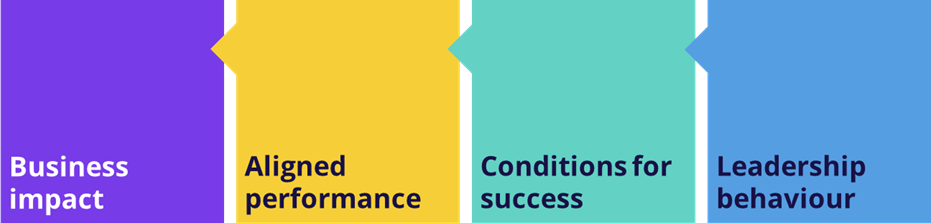
Read right to left, it describes how leadership creates value. Leaders behave in certain ways. Those behaviours create conditions for teams and team members. Those conditions enable teams to perform. And that performance drives business outcomes.
But the power of the model comes from using it in the other direction.
Instead of starting with content, you work backwards from the result the organisation is trying to achieve by asking four questions:
- Business impact - What business result are we actually trying to achieve and why?
- Aligned performance - What would teams need to do differently to deliver it?
- Conditions for success - What would teams need around them to perform that way?
- Leadership behaviour - What would leaders need to do to create those conditions?
The answer to that final question becomes the basis for the learning brief.
And that changes the quality of the conversation dramatically.
A Walkthrough: Turning a Vague Brief into a Useful One
Let’s look at the kind of request L&D teams and vendors receive every day.
A 90-minute virtual masterclass for retail managers on coaching for performance and engagement.
At first glance, it sounds reasonable.
But if you look closely, it is almost entirely content:
- A topic
- A format
- An audience
It says very little about what should actually change afterwards.
On its own, it is difficult to design against and even harder to measure meaningfully.
The Leadership Impact Chain helps turn that request into something more commercially useful.
Step 1 - Clarify the business impact
Start with the business outcome.
In a retail environment, the real outcome is unlikely to be “better coaching.” It is more likely something closer to: Improve store performance to increase profitability.
That framing matters. Because once the real business objective is visible, the conversation immediately becomes more specific and more commercially grounded.
Step 2 - Identify the performance shift required
Next ask: What would store teams need to do consistently for profitability to improve?
For example:
- Execute store standards consistently
- Deliver excellent customer service
- Meet daily sales and operational targets
- Maintain strong safety practices
These are concrete performance expectations, visible on the floor everyday.
Step 3 - Define the conditions required for that performance
Teams do not perform that way by accident. Performance is shaped by the environment leaders create around people. So, the next question becomes: What conditions would help teams consistently perform this way?
For this example, the answer might include:
- Team members feeling trusted and valued
- Accountability being clear and consistent
- People taking ownership for customer experience
- Ongoing development building confidence and capability
- Daily rhythms and routines that support the above
In other words: an engaged, empowered, and accountable store environment.
Step 4 - Identify the leadership behaviours that create those conditions
Only now do we arrive at the leadership capability itself. And notice how much sharper the question has become. We are no longer asking: “What should retail managers learn about coaching?”
We are asking: “What specific leadership behaviours would help create an engaged, empowered, accountable store environment?”
For this brief, the answer might include behaviours such as:
- Asking open questions
- Listening actively
- Recognising good work
- Using short coaching moments during trade
- Encouraging ownership in day-to-day interactions
That becomes the real brief. Not “deliver coaching training.”
But: Help retail managers consistently use every day coaching behaviours to build an engaged and accountable team environment, enabling stronger store performance.
That is a fundamentally more useful commissioning conversation.
Hidden Benefit 1: Better Learning Objectives
Once the logic becomes clear, the learning objectives become sharper too.
Instead of broad objectives like:
- Understand the principles of coaching
- Learn coaching models
You get objectives connected to business logic:
- Ask curious questions during daily interactions so team members feel trusted to think and act independently.
- Listen actively and acknowledge contributions so team members take ownership for customer experience and performance.
- Use brief in-the-moment coaching conversations during trade so team members continue building confidence and capability.
- Recognise effort and growth authentically so team members feel valued, even during high-pressure periods.
Every objective now has a reason for existing. The learning is no longer justified because it is interesting or fashionable. It is justified because it connects to the conditions required for business performance.
This is the chain showing through. The objective is never "understand coaching." It is a specific behaviour, tied to a specific condition, that ladders up to team performance and this leads to profitability.
Hidden Benefit 2: Better Vendor Conversations
The Leadership Impact Chain can improve the quality of conversations organisations have with learning providers. Without a clear chain of logic, vendor selection often becomes a comparison of:
- Facilitation style
- Methodologies
- Content libraries
- Program aesthetics
- Price
But once the business logic is explicit, proposals can be evaluated differently. You can ask:
- Does this solution address the actual performance shift required?
- Does it build the conditions leaders need to create?
- Are the proposed learning activities aligned to the behaviours we need leaders to practise?
- Can the provider explain how the learning connects to the business outcome?
The conversation becomes less about whose program sounds most impressive and more about whose reasoning is strongest.
That is a far more useful basis for investment decisions.
Designing Better Leadership Development Starts with Better Briefing
Leadership development often struggles to demonstrate value because the connection to business performance was never clearly defined in the first place. The Leadership Impact Chain offers organisations a practical way to think more clearly before solutions are designed, vendors are engaged, or budgets are committed.
It helps transform learning briefs from:
“We need training on coaching.”
into:
“We need leaders to create the conditions that enable stronger store performance.”
That shift changes the quality of everything that follows:
- The learning objectives
- The design decisions
- The vendor conversations
- The measurement strategy
- And ultimately, the likelihood that the program creates meaningful business impact
Because when leadership development can be traced back to business outcomes from the very beginning, it stops being a collection of topics and starts becoming a business intervention.
%20(1).png)
.png)